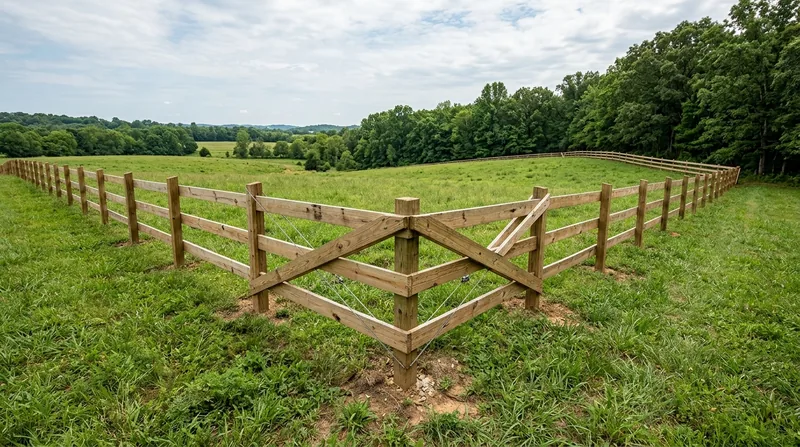




Farm fence installation in Fayetteville serves the working landscape of Washington, Benton, and Madison counties. Properties beyond the county line need fencing that holds livestock pressure, weathers seasonal cycles, and accommodates the equipment that moves through gates every day. Whether you're securing pasture, containing cattle and horses, or defining field boundaries on acreage, the fence has to be built for the job, not just the view. We install ranch rail, no-climb horse fence, field wire, and pipe fencing that stays sound through years of use. Since 2014, we've worked with landowners across Greater Fayetteville to build fences that earn their keep.
Why Ranch and Farm Fencing Matters in Fayetteville
Fayetteville-area properties with acreage face real demands: containing livestock safely, keeping predators out, and managing access across working ground. A fence on a farm or ranch is infrastructure, not decoration. It takes the weight of animals leaning into it, the stress of gates opening and closing under load, and the exposure of an open landscape. Residential-grade fencing simply doesn't perform under that pressure. The post spacing, rail gauge, and hardware must be chosen for the specific animal and the specific job.
- We set posts deeper and space them closer for livestock containment than residential fencing requires.
- We use galvanized pipe and hardware rated for outdoor agricultural use and corrosion resistance.
- We install anti-sag bracing on rail sections to hold their shape under sustained animal pressure.
- We build gates with heavy hinges and self-closing hardware that handles daily equipment traffic.
- We work with no-climb mesh and field wire sized to contain the species and size of animal you're keeping.
The difference shows up in the third year and beyond, when a properly built farm fence is still working and a compromise fence is failing.
Key info: Fayetteville and surrounding areas are home to active livestock operations, hobby farms, and horse properties. The Fayetteville Building Department and Benton County Code set height and setback rules for property lines. We always verify local requirements before we start, and we work from your existing survey to install on the line you identify. Before any digging, we call 811 for a utility locate, as required by Arkansas law.
For more on the regulatory side of fencing in Fayetteville, visit the City of Fayetteville Planning and Development Services website to confirm setback and height rules for your property.
How We Install Farm and Ranch Fencing: A Fayetteville Approach
Building a farm fence starts on the ground. We assess the terrain, identify obstacles, and plan post placement to handle the land as it sits. Acreage in and around Fayetteville varies in slope and exposure. We step or rack the fence to follow grade changes, keeping tension even and preventing sag. Posts are set in concrete below frost depth, and every rail and wire is secured with hardware sized for the load it will carry.
- We mark the fence line with you and call 811 before any post holes are dug.
- We dig post holes at the depth and spacing your fence type requires, using power equipment for speed and precision.
- We set posts in concrete and allow proper cure time before hanging rails or wire.
- We attach rails or mesh with galvanized fasteners and check tension and alignment as we go.
- We install gates on heavy hinges with latches and hardware rated for repeated use and animal pressure.
- We walk the completed fence with you to confirm everything is secure and operating as intended.
The result is a fence that you can trust to do its job without constant repair and adjustment.
Local example: A property owner in Lowell with 10 acres and three horses needs no-climb horse fence installed across a gently sloped pasture. We set posts every 6 feet, use 1.5-inch galvanized pipe for the top two rails, and install 4-inch no-climb mesh below. Gates are hung on heavy hinges with self-closing latches. The job takes about 3 to 4 working days and delivers a fence that holds safely under years of daily use.
For more detail on how we handle other fencing work in the area, see our Fence Repair page.
Farm and Ranch Fencing Methods in Fayetteville
| Approach | Description | Best for |
|---|---|---|
| Ranch Rail | Two or three horizontal rails of pressure-treated pine or cedar, set in posts spaced 6 to 8 feet apart. | Horses, cattle, and pasture definition; visible from the road; lower cost than pipe. |
| No-Climb Horse Fence | Horizontal rails with vertical mesh woven between, or solid mesh panels, preventing animals from climbing or catching hooves. | Horses and livestock that test fences; high-traffic pastures; maximum safety and durability. |
| Pipe Fencing | Galvanized steel pipe (1.5 to 2 inches) set in concrete posts, with or without mesh below. | Heavy livestock, high-impact use, long-term durability, and minimal maintenance. |
| Field Wire and Barbed Wire | Wire mesh or barbed wire strung between posts, often combined with top rails for visibility and strength. | Cattle containment, perimeter fencing on large acreage, and cost-effective boundary definition. |
| Split Rail | Two or three split cedar rails set in mortised posts, a rustic style requiring no fasteners. | Aesthetic rural properties, lower traffic areas, and traditional ranch appearance. |
Farm and Ranch Fencing Cost in Fayetteville: What to Expect
The cost of farm fence installation in Fayetteville depends on the material you choose, the terrain, and the distance of the fence line. Ranch rail and split rail typically start at $11 per linear foot and move up with the quality of the wood and the complexity of the installation. Pipe fencing, which is more durable and requires deeper post holes and concrete, runs higher. Field wire and barbed wire are the most economical options for large acreage, while no-climb horse fence sits in the mid-range and offers excellent value for high-traffic pastures.
Several factors affect the final price. Gates add to the total and vary by size and hardware. Sloped or rocky ground increases labor and equipment time. Long runs with few obstacles cost less per foot than short runs with multiple obstacles. Accessibility for our truck and equipment matters. We always quote travel as included in the Fayetteville service area, so you're not surprised by mileage fees.
The best way to understand cost for your property is to get an estimate on-site. We'll walk the fence line with you, assess the terrain and soil conditions, and give you a clear price. For detailed pricing across all our services, see our pricing page.
Farm and Ranch Fencing Near Me: What Fayetteville Homeowners Should Know
Finding the right contractor for farm and ranch fencing starts with understanding what you're getting. We've been in business since 2014 and are fully insured and an AFA Member Installer with the American Fence Association. We don't use subcontractors; the same crew that estimates your job builds it. We provide references from properties across Fayetteville, Springdale, Rogers, Bentonville, and surrounding areas, and we're happy to share them with you.
When you're comparing contractors, ask about their experience with the specific type of fence you need. A contractor who builds residential privacy fences may not have the expertise to handle livestock pressure and gate operation. Ask to see examples of ranch rail, no-climb, and pipe fencing installations. Understand what's included in the estimate: posts, rails, mesh, gates, hardware, and labor. Confirm that they call 811 before digging and that they know local setback and height rules.
Permit requirements vary across the Fayetteville area. Some jurisdictions require a permit for farm fencing, and others do not. We verify the rules for your property and help you navigate the process. If you're in an HOA or deed-restricted community, architectural review may be required even on acreage. We'll confirm that with you before we start.
Ready to move forward? Contact us for a free estimate. Call (479) 480-5456 and describe your property and your fencing needs. We'll schedule a walk-through, answer your questions, and provide a detailed price with no obligation to book.
Farm & Ranch Fencing in Fayetteville: Pricing Guide
| Service | Price | Details |
|---|---|---|
| Ranch Rail Fencing | Starting at $11/ft | Two or three horizontal rails, pressure-treated pine or cedar, posts set in concrete 6-8 feet apart |
| No-Climb Horse Fence | Starting at $16/ft | Horizontal rails with vertical mesh or solid panels, installed for maximum safety and livestock containment |
| Pipe Fencing | Starting at $18/ft | Galvanized steel pipe 1.5 to 2 inches, set in concrete, with or without mesh for heavy livestock use |
| Field Wire and Barbed Wire | Starting at $7/ft | Wire mesh or barbed wire strung between posts, economical option for large acreage and cattle containment |
| Gates and Hardware | On estimate | Heavy-duty hinges, latches, and self-closing mechanisms sized for repeated use and animal pressure |
| Free Estimate | No obligation | On-site walk-through, terrain assessment, and detailed price breakdown within 24 hours at (479) 480-5456 |
Indicative pricing, the exact cost depends on square footage, finish, and site access. Free personalized estimate within 24h at (479) 480-5456.


