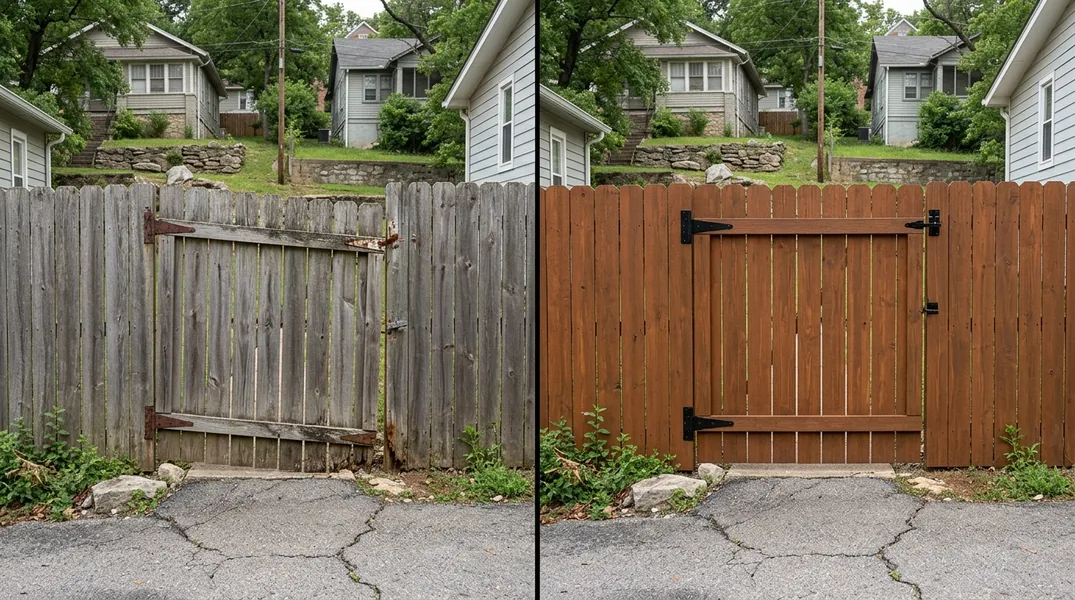
Understanding Racked vs. Stepped Fences on Slopes
If you own property in Fayetteville or the surrounding Ozark region, you know that hillsides and uneven terrain are part of the landscape. When it comes to installing a fence on a slope, homeowners face a critical decision: should they use a racked fence or a stepped fence? Understanding the difference between these two approaches is essential before moving forward with your project.
A racked fence follows the natural contour of the slope by tilting the fence panels at an angle that matches the grade of the land. The top and bottom rails remain parallel to each other, but the entire panel leans to accommodate the hillside. This creates a uniform appearance where the fence line flows smoothly with the terrain. In contrast, a stepped fence maintains vertical posts and horizontal rails at right angles, creating a stair-step pattern as it descends the slope. Each section of fencing remains level and plumb, but visible gaps may appear between the bottom of the fence and the ground as elevation changes.
Why Racking Works Best for Northwest Arkansas Hillsides
Northwest Arkansas presents unique challenges for fence installation due to its rolling topography and clay-heavy soil composition. Racking has emerged as the preferred solution for most residential Wood & Privacy Fence Installation projects on sloped properties. The racking method distributes stress more evenly across the fence structure, reducing the likelihood of panels warping or twisting over time as the ground shifts with seasonal moisture changes, a common issue in our region.
The visual appeal of a racked fence is another significant advantage. Because the fence line remains continuous and follows the natural slope, the finished product looks intentional and professional. Homeowners in Fayetteville appreciate how a properly racked privacy fence maintains the aesthetic flow of their landscape while still providing complete security and privacy. The fence doesn't appear to fight against the terrain, which can happen with stepped designs on gentler slopes. For slopes with grades between 10 and 25 degrees, racking is almost always the recommended approach.
When Stepped Fence Panels Make Sense
While racking dominates the market for moderate slopes, stepped fence panels become necessary on steeper terrain. When your property has a grade steeper than 25 to 30 degrees, attempting to rack a fence can create panels that tilt so dramatically that they lose structural integrity and aesthetic appeal. Stepped fencing maintains the vertical strength of each section, making it safer and more durable on severe hillsides. Each step is essentially a level fence section, and the posts remain perfectly plumb, which is crucial for long-term stability.
Stepped fences also work well when you need maximum ground coverage and minimal gaps. If wildlife exclusion or complete privacy is your primary concern, the stepped approach ensures that each section of fencing sits as close to the ground as possible. The step-down pattern may be more visible than a smooth racked design, but the structural benefits often outweigh aesthetic considerations on very steep properties. Many homeowners in the area also choose stepped fences when they want to create distinct terraced zones on their property, using the fence as a visual and functional boundary between different elevation levels.
Wood & Privacy Fence Installation Cost in Fayetteville: What to Budget
The pricing for a racked or stepped fence installation in Fayetteville depends on several factors beyond the standard per-linear-foot rate you might see advertised online. Slope complexity, soil conditions, local building codes, and material selection all influence the final cost. Racked fences typically cost slightly less than stepped fences because they require fewer posts and less custom cutting, but the difference is often modest. A standard privacy fence might run between $25 and $45 per linear foot on level ground, but sloped installations can add 15 to 40 percent to that base cost depending on the grade severity.
Material choice also significantly impacts your investment. Cedar and pressure-treated pine are popular choices for privacy fences in our region and offer good durability and appearance. If you're considering Vinyl & PVC Fence Installation as an alternative, vinyl racking systems are available, though they typically carry a higher upfront cost. The advantage is minimal maintenance and longer lifespan. For an accurate quote tailored to your specific slope and property conditions, contact Fayetteville Fence Contractors at (479) 480-5456 or request a free estimate through our website. Our team can assess your terrain and provide transparent pricing based on your exact situation.
Technical Considerations for Racking Fence Installation
Proper racking installation requires precision and experience, which is why hiring a professional contractor matters. The key to a successful racked fence is calculating the correct angle for each panel based on the slope's grade. Contractors use slope measurements and specialized tools to determine the precise tilt needed so that the fence maintains uniform appearance and structural strength. The posts must be set at the correct depth and angle, and the rails need to be cut or adjusted so they remain parallel to each other even as the panel tilts.
Soil preparation is critical in Northwest Arkansas, where clay content can affect post stability. Posts must be set deep enough to anchor properly, and in some cases, concrete footings need to be poured at angles that match the slope. The pickets or boards that form the fence face also require careful installation, as they must be cut to length individually to accommodate the racking angle. This level of detail is why attempting a DIY racked fence installation on a significant slope often leads to problems. Professional contractors have the experience, tools, and knowledge to navigate these technical challenges and ensure your fence stands strong for decades to come.
Maintenance Tips for Sloped Fences in Our Climate
Once your racked or stepped fence is installed, understanding how to maintain it will extend its lifespan significantly. Northwest Arkansas experiences freeze-thaw cycles, humidity fluctuations, and seasonal rainfall that can stress fence materials. Wood fences benefit from regular sealing or staining every two to three years, which protects against moisture penetration and UV damage. Check your fence annually for signs of rot, particularly at ground level where moisture tends to accumulate. On sloped properties, water runoff patterns can accelerate wear on the lower sections of your fence, so pay special attention to drainage around the base.
Stepped fences may require additional attention at the transition points between sections, where gaps can trap debris and moisture. Keep these areas clear and consider applying additional sealant at joints if you're using wood. For both racked and stepped installations, inspect posts regularly for movement or settling, especially after heavy rains when soil is most active. If you notice any leaning, gaps, or structural concerns, contact a professional promptly to prevent minor issues from becoming major repairs. With proper care, your sloped fence will provide privacy, security, and curb appeal for 15 to 20 years or more, depending on material choice and climate exposure.
Looking for a professional tree service in Fayetteville? Fayetteville Fence Contractors responds fast for all your fence needs.
Get a Free Quote